

News

Casio Prizm announced, is it a TI-Nspire Killer?

UPDATE: It is now possible to buy a Casio Prizm. To get highly anticipated calculator, click here to buy your Casio Prizm on Amazon. UPDATE: My Casio Prizm review is now live. You float into classroom, hovering over the desks. All around you, colors are radiating throughout the classroom You make your way to the teacher’s desk, where you see a TI-Nspire Clickpad. Suddenly, in a flash of color, the Nspire transforms to a new calculator you’ve never seen before with amazing new capabilities.


Continue reading

South African students study math via cell phone

The Associated Press reported on Thursday about an unusual experiment occurring out of necessity in South Africa. With students preparing for required graduation exit exams just less than a month a way, droves of them are turning for MXit, a popular instant messaging service, for assistance. Specifically, the students are using MXit to get answers to their math questions. Tutoring by cell phone was made necessary following a nationwide strike of South African teachers just before the all important exams.

Continue reading

Facebook-Ally in math education?

The Hill is reporting that on Thursday math students and educators gained a new ally in the quest for better math education in America–Facebook.  On Thursday, the popular social networking site sent a letter to Congressional leaders asking for more funding for math, science, and technology education, expressing concerns that if action isn’t taken, America will fall behind its competitors in these key areas. Excerpts from the letter follow: The shortage of students entering STEM careers has long been recognized in Washington, Silicon Valley, and beyond.

Continue reading

Lyric probability processor

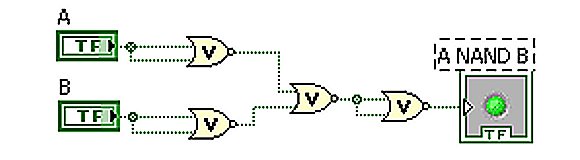
Since the first electronic computers were developed over 60 years ago, they have operated in a fundamentally similar way. Lyric Semiconductor recently announced a new kind of computer processor that is a shocking change in the math behind computers. You may know that computers “speak” binary, meaning that at a fundamental level, they operate on the base two number system, a series of 0’s and 1’s. The reason for this is that those 0’s and 1’s can be easily translated into what sort of amounts to a long list of yes/no or true/false questions for the computer to crunch.

Continue reading

New pi world record

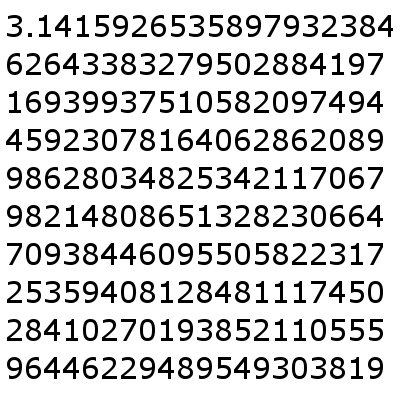
All hail Shigeru Kondo, the new king of pi! According to The Daily Telegraph, Mr. Kondo, a systems enginer, has broken the world record for the most digits calculated of pi, finding the ratio of a circle’s circumference to diameter to a mind-blowing 5 trillion places. For those unfamiliar with pi, it is an irrational number, meaning that when expressed in decimal form, its decimal continues forever without ever reaching a repeating pattern.

Continue reading

Video: Microsoft math add-in for Word and OneNote

Click here for our article on the Microsoft Mathematics Add-in for Word 2010 and OneNote.

Continue reading

Calculator Spy Camera

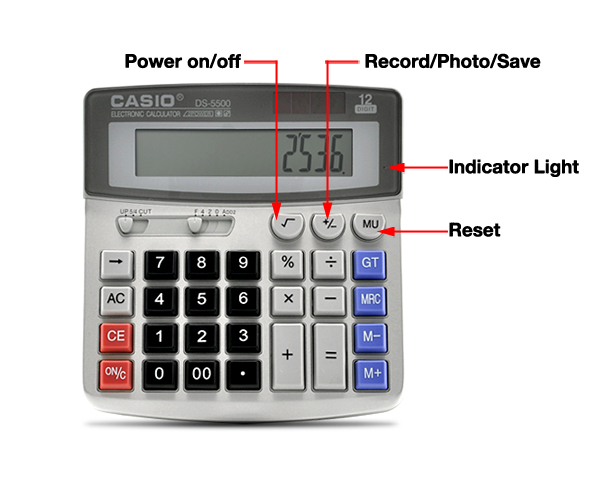
Here’s a gadget that we didn’t see coming: a calculator that doubles as a spy camera. If you’d like to keep tabs on anyone from your babysitter to your colleagues, this device delivers. The calculator copies the design and functionality of a Casio DS-5500, so it is a usable calculator. It records at 640 x 480 resolution at 30 frames/second. Apparently, it can also take 1280 x 960 pictures, for those of you that plan to use it as a replacement for your digital SLR.

Continue reading

Microsoft math add-in for Word and OneNote

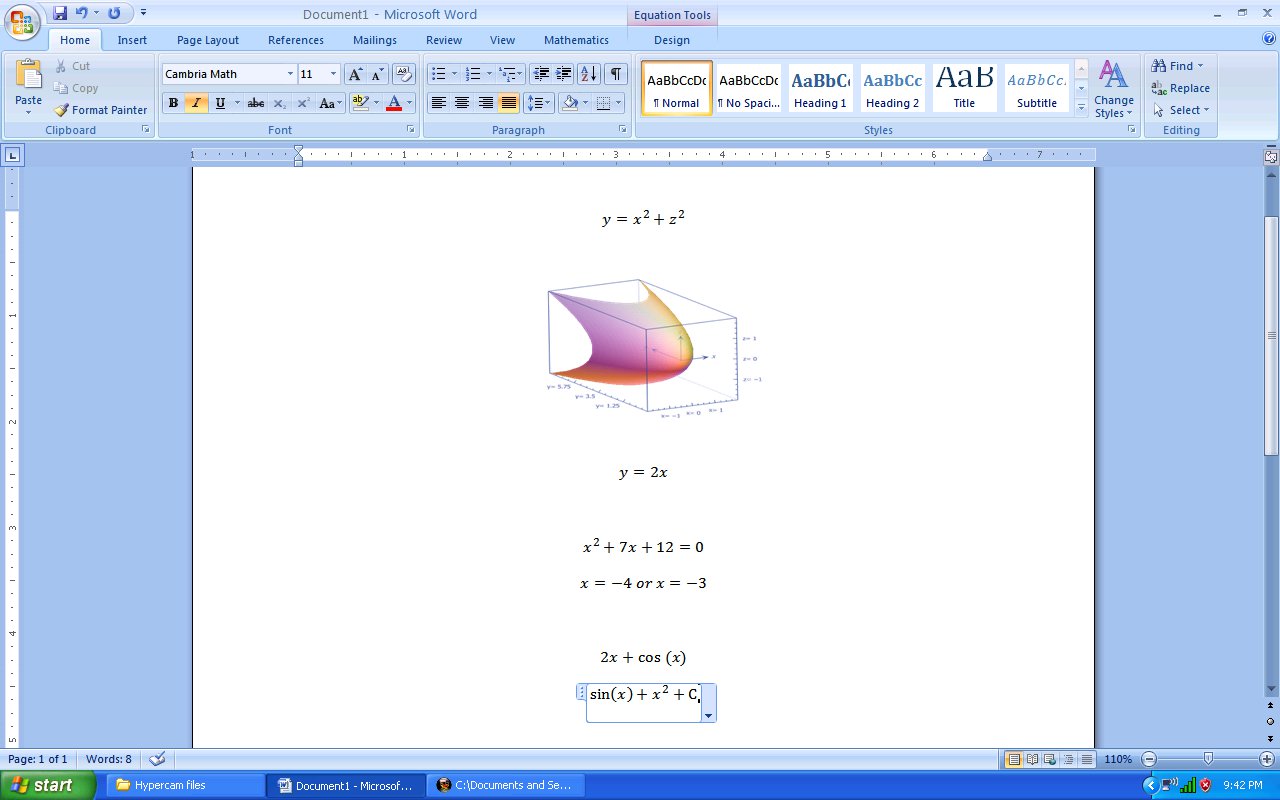
Click here for my video of the Microsoft Mathematics Add-in for Word 2010 and OneNote. On Tuesday, Microsoft released the Mathematics Add-in for Word 2010 and OneNote users.  If you’ve never used equation editor or a previous release of the mathematics add-in, it gives significant mathematical capabilities to Word.  Teachers (myself included) love it for writing quizzes, tests, and worksheets.  Students will appreciate the ability to easily make their assignments and papers look more professional.

Continue reading

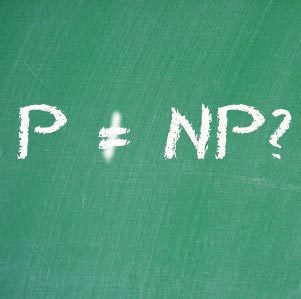
Million Dollar question: Does P = NP?

In an age where we are surrounded by computers that solve problems of almost unimaginable complexity in a matter of seconds, students of math may be surprised to learn that there is an entire category of problems generally believed to be “unsolvable” by computers.  The class of P problems can be solved in “polynomial time,” while NP problems are solved in “nondeterministic polynomial time.” At the risk of oversimplifying, P problems can be solved by a computer fairly quickly.

Continue reading